
Membership strategy · India
Gym Membership Pricing in India: A Plan Design Guide
Turn a headline fee into a clear, testable plan with exact duration, honest price math, renewal rules, freeze terms and preserved history.
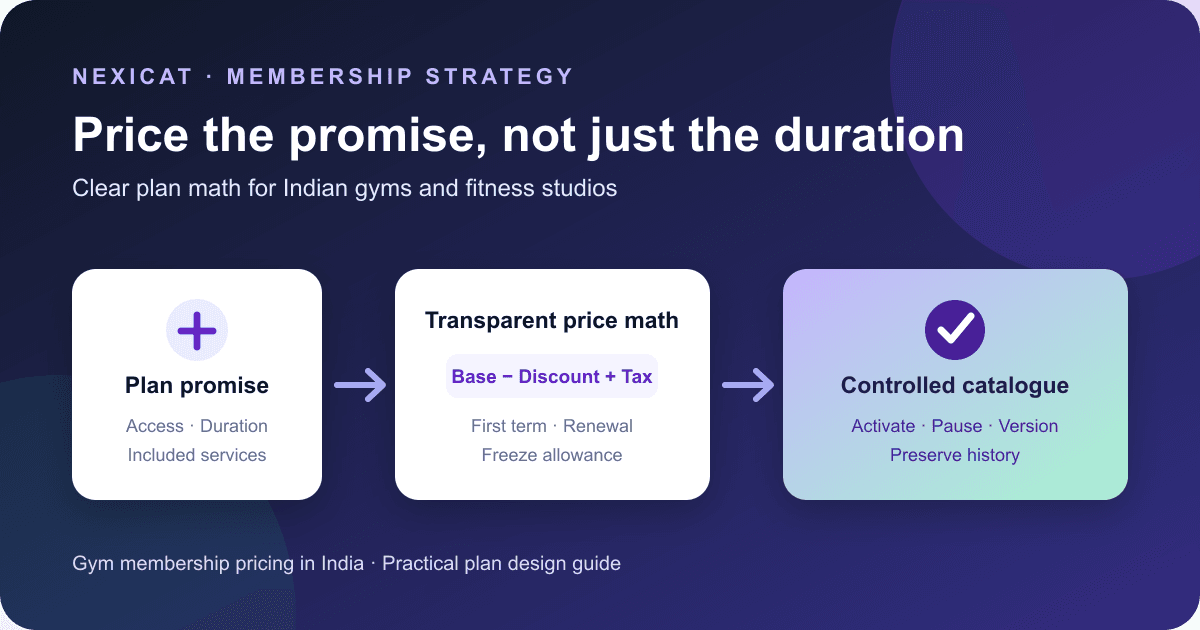
1. Separate member pricing from software pricing
This guide is about the price a gym offers its members—not the subscription a gym pays for management software. Member pricing combines a service promise, duration, access rules, discount policy, tax treatment, renewal terms and pause rights.
There is no defensible single “average gym fee in India” for every city, facility and service model. Rent, capacity, coaching, equipment, opening hours and local alternatives differ. Use your own records and a clearly defined offer rather than copying a competitor's headline price.
If you are comparing the cost of operating software instead, use the gym management software cost guide. Keep the two decisions in separate worksheets so a software quote does not accidentally become a member price benchmark.
2. Define the plan promise before choosing a number
Write one plain-language sentence describing who the plan is for and what it includes. Then list access hours, eligible branches, group classes, induction, trainer time, lockers or other services, plus anything sold separately.
Avoid vague names such as “Premium” unless the difference is visible. Do not promise weight loss, muscle gain, injury prevention or another health result merely because a member buys a longer plan. The service promise should describe what the gym will provide, not guarantee what a person's body will do.
Nexicat's current membership-plan record stores a name and description alongside its commercial fields. It does not provide a structured entitlement catalogue for branch access, class quotas, guest passes or PT sessions. Put important exclusions in the approved offer and test any access rule in the relevant workflow.
3. Use exact durations and calendar rules
Choose durations that match the service, cash-flow need and member commitment you can support. Write the duration as an exact number of days and show the start and end dates during enrolment. “Monthly” can be ambiguous when months have different lengths.
Nexicat currently stores plan duration in days. Its owner screen displays the duration, and the member app describes 30 days as monthly, 365 days as yearly and other values by their day count. Membership dates are separate records, so staff should confirm the actual access window rather than calculating it from a label in conversation.
Test starts at month-end, leap day, future dates and renewals bought before expiry. The membership lifecycle guide covers the date hand-off in more detail.
4. Build a price floor from your own service economics
Start with a fixed review period and calculate the cost of delivering the plan: allocated facility and equipment cost, payment costs, included coaching or classes, member servicing and a reasonable contingency. Add the contribution the business requires, then test whether expected capacity can support it.
Use a worksheet, not a copied market number:
- planned revenue: number of memberships you reasonably expect to sell × actual selling price;
- planned delivery cost: fixed allocation + expected variable service cost;
- planned contribution: planned revenue − planned delivery cost; and
- capacity check: expected visits or class seats against the capacity actually available.
These are planning formulas, not industry benchmarks. Keep optimistic and conservative cases separate. A low upfront price can still be expensive to deliver when it includes high-touch coaching, peak-time classes or frequent freezes.
5. Show base price, discount, tax and payable price clearly
A member should be able to understand the price before agreeing. Show the base price, one authorised discount, taxable value, applicable tax and final payable amount. If a tax is not included in the headline, make that clear before checkout or enrolment—not after confirmation.
Nexicat's current plan setup accepts a base price and either a percentage discount or a fixed-value discount, not both. It calculates the discounted amount, applies the gym's configured tax percentage and stores a final member price. The owner screen labels base price as before discount and tax and final price as including tax; the member app presents the price breakdown when configuration is available.
The CCPA's Guidelines for Prevention and Regulation of Dark Patterns, 2023 describe drip pricing as hiding price elements or revealing a higher price late in the journey. CBIC's current GST rates table and tax-invoice rules are authoritative starting points, but classification, registration and invoicing depend on current facts. Ask a qualified tax adviser; software calculation alone does not establish compliance.
6. Treat a discount as a controlled rule, not a negotiation habit
Write the reason, eligible audience, start and end dates, approval owner and whether the discount applies only to the first term. Avoid permanent “limited-time” claims, inflated reference prices and staff-specific deals that cannot be reconstructed later.
Nexicat lets a plan use a percentage or flat discount and prevents a flat discount from exceeding the base price. It also calculates a separate renewal price. The reviewed model does not store promotion dates, coupon eligibility, approval history, reason codes, per-member negotiated prices or a public strike-through-price history in the plan record.
For campaign or corporate offers, preserve the approved terms outside the plan unless the demonstrated workflow stores them. Never infer discount authority from a staff member's ability to edit the catalogue.
7. Publish the renewal price rule before the first sale
A discounted joining price can create conflict if the renewal returns to the base price without a clear explanation. State whether the discount repeats, when the next price is reviewed and how members will be told about a material change.
Nexicat has an apply discount on renewal setting. When enabled, the discounted final price carries into the calculated renewal price; when disabled, renewal is calculated from the base price plus configured tax. Owner and member views display the renewal treatment and price.
That setting is a pricing rule, not automatic collection or consent. The reviewed plan model does not create a renewal contract, collect a mandate, schedule an automatic debit or prove that a member received a price-change notice. Use the renewal reminder guide for the communication workflow.
8. Price the freeze promise into the plan
A freeze allowance has economic value because it can extend access beyond the original term. Decide whether freezes are allowed, the maximum days per renewal period, eligible reasons, notice requirements and how early return works. Explain the rule before the member pays.
Nexicat stores a maximum freeze-days allowance per renewal on the plan and shows it in owner and member views. The current freeze workflow counts inclusive dates, tracks used days and extends the membership renewal date when staff explicitly unfreeze the membership. It does not establish a freeze fee, automatic approval or automatic end-of-freeze resumption.
Use the gym membership freeze policy guide to test those operational details. A plan with generous pause rights should not be compared to a no-freeze plan on headline price alone.
9. Version offers instead of rewriting history
When changing price, duration or benefits, decide whether the change applies only to future sales, future renewals or existing terms where permitted. Preserve what was offered and accepted for each sale. Do not edit a shared catalogue record and assume historical meaning will remain obvious.
Nexicat supports active and inactive plans. The member app lists active plans for browsing, while the backend refuses to delete a plan already assigned to one or more members and directs staff to pause it instead. Plan names must be unique within the gym.
The reviewed plan record does not expose an effective-from date, immutable version number, grandfathering rule, branch-specific availability or stored terms acceptance. For a material new offer, create a separately named plan, pause the old plan for new sales and verify existing membership and invoice records before rollout.
10. Measure plan mix carefully and test the hard cases
Review active members by plan, actual invoices, collections, refunds, freezes, renewals and capacity. Do not call a catalogue-price estimate “revenue.” Nexicat's current plan analytics estimates a monthly revenue mix as final plan price ÷ duration days × 30 × active members. It is a normalised catalogue estimate, not actual cash collected, tax-exclusive revenue, renewal revenue or recognised accounting revenue.
Use fictional plans in a demo and ask Nexicat to:
- create two plans with clear descriptions and exact durations;
- reject simultaneous percentage and flat discounts;
- reconcile base, discount, configured tax and final price;
- compare first-term and renewal prices with the renewal toggle on and off;
- show the freeze allowance in owner and member views;
- pause a plan and prove it leaves the new-sale list without erasing assigned history;
- refuse deletion while a member uses the plan;
- explain what changes when a shared plan is edited;
- reconcile the analytics estimate against actual invoices and payments; and
- identify versioning, promotion dates, per-member negotiation and acceptance evidence as unsupported unless demonstrated.
Explore membership management or book a Nexicat demo with your real plan rules and fictional member records.
Test the price promise
Bring one real plan rule to the demo.
Use fictional members and payments to reconcile duration, discount, configured tax, renewal price, freeze allowance, catalogue changes and actual finance records.
Gym membership pricing questions
How should a gym set membership prices in India?
Define the service and access promise, calculate a price floor from the gym's own delivery economics, test capacity, document discounts and renewal terms, and show tax and final payable price clearly. A copied city-wide average is not a substitute for branch-level costs and positioning.
Should a gym offer monthly and annual plans?
Only when each duration fits the gym's service model, cash flow, capacity and member promise. Use exact dates, explain what differs, and model the delivery cost and freeze exposure rather than assuming a longer plan should always receive a particular discount.
Can Nexicat apply both a percentage and flat discount?
No. The reviewed plan service requires one discount method at a time. It calculates the discounted price and then applies the gym's configured tax percentage to produce the final price.
Does a joining discount automatically continue at renewal?
Only if the plan's apply-discount-on-renewal setting is enabled. Otherwise Nexicat calculates renewal from the base price plus configured tax. The rule should still be explained to the member before the first sale.
Which membership-pricing features does Nexicat currently support?
Reviewed code supports plan names and descriptions, day-based duration, base price, one percentage or flat discount, calculated first-term and renewal prices, configured tax, renewal-discount choice, freeze-day allowance, active status, assigned-plan deletion protection, member plan views and a normalised plan-mix estimate. Promotion schedules, immutable plan versions, grandfathering, negotiated member prices and automatic collections are not claimed.
About Nexicat Editorial. We write practical guides to gym operations and software evaluation. Sources linked beside the relevant guidance were checked on 8 November 2026. This guide provides general pricing and operational information, not tax, legal, accounting or financial advice. Rules and products change; verify current official guidance and obtain qualified advice before rollout.