
Software investment · India
Gym Management Software ROI in India: A Measurement Guide
Measure gym software with a reproducible baseline, full ownership cost and verified financial benefits—without relying on sales promises.
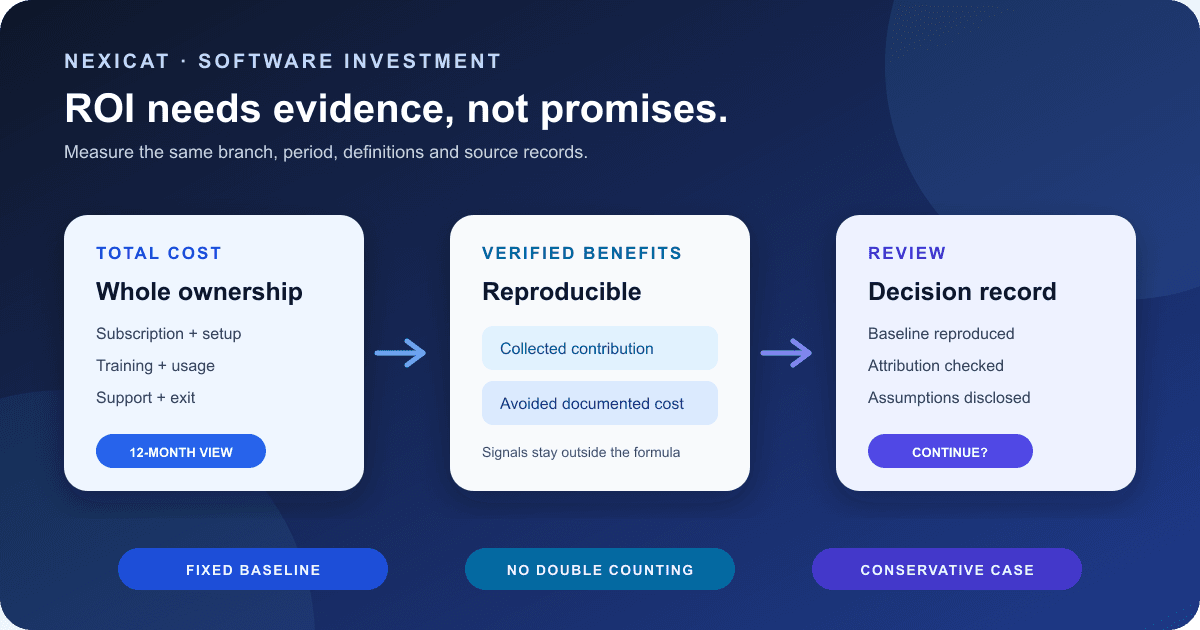
1. Define the decision before calculating ROI
Return on investment is useful only when it answers a specific decision. Write down the software option, branches, users, workflows, start date and measurement period before entering any benefit.
Use a fixed comparison such as the same branch before and after rollout, or a phased rollout with a comparable branch. Record what else will change during the period: membership prices, opening hours, trainers, marketing spend, equipment, campaigns or a branch move. Those changes can affect the result.
Do not begin with a vendor's promised percentage. Begin with the gym's current records and a decision such as: “Should this branch continue with the platform after the first review period?” This article uses a 12-month ownership view because it captures recurring and setup costs, but it does not prescribe a universal contract term or payback target.
2. Build the full cost of ownership
The subscription is only one cost. List every amount required to put the system into use and keep it operating:
- licence or subscription charges and applicable taxes;
- setup, configuration, migration and data-cleaning work;
- staff training and parallel-run time;
- devices, scanners or other required hardware;
- payment, messaging, storage or usage-based charges;
- support, custom work and integration costs; and
- export, retraining, migration and contract-exit costs.
The Government of India's Department of Expenditure describes total cost of ownership as the costs incurred across acquisition, use and end of life, rather than purchase price alone. Its procurement manual is not a gym-software rule, but the cost categories are a useful discipline.
Use the gym management software cost guide to create a comparable 12-month cost sheet. Ask vendors to label inclusions, limits and optional charges in writing.
3. Freeze a baseline the gym can reproduce
Choose a pre-rollout period and preserve the source records. The baseline should use definitions that can be repeated after implementation.
Useful candidates include collected membership revenue, outstanding amounts, renewals due and completed, valid leads and conversions, member visits, class bookings and attendance, inventory losses, payroll cost and measured admin time. Select only the measures connected to the problem the software is expected to change.
For every measure, record the date range, branch, included statuses, source file or report, formula and owner. “Revenue improved” is not reproducible. “Collected membership amount for paid and partially paid invoices issued at Branch A during the calendar month” is much clearer.
If the old register or spreadsheet cannot produce a trustworthy baseline, say so. Start measuring cleanly after rollout and delay the ROI conclusion rather than inventing the missing number.
4. Count only benefits with evidence
Separate benefits into categories so the same rupee is not counted twice:
- Incremental contribution: additional collected revenue minus the direct cost of delivering it.
- Avoided cost: a cost the gym would otherwise have paid, supported by a cancelled invoice, avoided hire or other evidence.
- Recovered leakage: money already due that was actually collected, not merely displayed as outstanding.
- Productive capacity: measured staff time that was reassigned to valuable work or removed from a paid requirement.
More leads, reminders, visits or dashboard views are operational signals, not cash benefits by themselves. A renewal that would have happened anyway is not automatically attributable to software. Gross revenue is not the same as profit or cash.
Keep non-financial improvements—clearer records, faster answers, fewer disputes or better member self-service—in a separate scorecard. They can support the decision without being forced into an unsupported rupee value.
5. Use one transparent ROI formula
Use the same formula for every option:
Verified net benefit = verified financial benefits − total software cost
ROI (%) = verified net benefit ÷ total software cost × 100
You can also track simple payback:
Payback period = total software cost ÷ average verified monthly benefit
Label the currency, tax treatment and period. If the average monthly benefit is zero or negative, do not report a meaningful payback period. If benefits or costs occur across several years, ask a finance professional whether discounted cash-flow analysis is appropriate.
MeitY's official open-source software policy document notes that ROI should include both organisational benefits and cost elements, and that total-cost analysis should consider exit, migration, retraining and compatibility costs. Use that principle without implying that the policy evaluates any gym product.
6. Protect the result from false attribution
Before calling a difference “software ROI,” check for other causes. Compare equivalent months where seasonality matters. Separate price increases from more renewals. Record marketing campaigns, trainer changes, new classes, closures and local events.
Use fixed cohorts for renewal and lead-conversion analysis. A member whose renewal became due in the measurement window belongs in the denominator even if the outcome is uncomfortable. Do not compare all members before rollout with only contacted members afterward.
Where possible, introduce one major workflow at a time or use a phased branch rollout. Keep an assumption register with the owner, evidence and confidence level for every claimed benefit. Run a conservative case that excludes uncertain benefits; the purchase should not depend on the most optimistic version.
7. Treat saved time as capacity, not automatic cash
Measure a repeated task before and after implementation using the same start and end points. Examples include preparing the renewal list, reconciling a day's collections, finding a member record or building a weekly report.
Do not multiply every minute saved by salary and call it profit. Time becomes a financial benefit only when it avoids paid overtime, replaces an external cost, prevents a planned hire or is deliberately reassigned to work with a measurable result. Otherwise record it as released capacity.
Track adoption as well. If staff maintain the software and a parallel spreadsheet indefinitely, the gym may add work rather than remove it. Include training, correction and duplicate-entry time in the cost side until the old process is formally retired.
8. Use Nexicat reports as evidence, not the conclusion
Nexicat's current reporting catalogue includes revenue mix, membership and renewal sales, outstanding collections, expenses, renewal pipeline, inactive members, new-client growth, plan value, staff cost, member footfall, class demand, class payments, lead conversion and inventory reports. Reports are scoped to the active gym and branch and use explicit dates and filters.
These reports can help reproduce the measures selected in the ROI plan. They do not prove that Nexicat caused a change. Export the relevant report, preserve its filters and reconcile financial totals with the underlying invoice, payment, expense or transaction records.
Use the weekly gym KPI guide for stable operational formulas. Keep ROI narrower: only verified changes that affect the software investment decision belong in the financial calculation.
9. Run a baseline, adoption and outcome review
Use three gates rather than waiting for one final number:
- Baseline gate: definitions, sources and starting values are signed off before rollout.
- Adoption gate: required workflows are used correctly, exceptions are resolved and duplicate systems are being retired.
- Outcome gate: the same reports are rerun, differences are reconciled and only supported benefits enter the ROI calculation.
Set dates based on the gym's renewal cycle, reporting cadence and contract decision. A short pilot may prove usability but may not contain enough renewals or collections for an ROI conclusion.
For each gate, record the owner, evidence, decision and follow-up. A negative or uncertain result is still useful: it may reveal poor adoption, unreliable source data, an unsuitable configuration or a workflow that should not be included in the business case.
10. Bring this ROI evidence plan to a Nexicat demo
Before the demo, choose one branch and two or three measurable problems. Then ask the demonstrator to:
- map each problem to the source records and responsible workflow;
- show the exact report, date range, branch scope and filters;
- drill from a total to the member, invoice, payment, attendance, lead or class record;
- prove role permissions for viewing and changing sensitive records;
- export a fictional report and explain its field definitions;
- show how corrections affect the report without rewriting history silently;
- identify subscription, setup, usage, hardware, support and exit costs;
- distinguish verified current features from configuration or future work;
- agree which baseline the gym must capture before rollout; and
- document what Nexicat cannot establish, including causation and accounting profit.
Use fictional data and compare the result with the software demo checklist. Then book a Nexicat demo with the evidence plan instead of asking for an ROI promise.
Bring evidence, not an ROI promise
Test the measurements behind your Nexicat business case.
Bring one branch, a fixed baseline period and two measurable problems. Test the source records, report definitions, filters, corrections, costs and product boundaries.
Gym software ROI questions
How do I calculate ROI for gym management software?
Add the full ownership cost, verify financial benefits over the same period, subtract cost from benefits, then divide the net benefit by total cost and multiply by 100. Keep assumptions, non-financial benefits and uncertain attribution separate.
What costs belong in a gym software ROI calculation?
Include subscription, setup, migration, data cleaning, training, parallel running, hardware, usage charges, support, integrations and foreseeable exit or replacement costs. Use the same time period and tax treatment for every option.
Can Nexicat guarantee a return on investment?
No ROI guarantee is made. Nexicat can provide connected operational records and reports, but results depend on the gym's baseline, adoption, pricing, staffing, market and other changes. The gym must verify benefits and attribution using its own data.
Is staff time saved a financial benefit?
Not automatically. Record time as released capacity unless it demonstrably avoids paid overtime, an external cost or a planned hire, or is reassigned to work with a measured financial result.
About Nexicat Editorial. We write practical guides to gym operations and growth. Sources linked beside the relevant guidance were checked on 15 October 2026. This guide provides general operational information, not financial, accounting, tax, procurement, contract or legal advice. Products, software and requirements change. Verify the offered setup with Nexicat and relevant qualified advisers.