
Gym analytics · India
Gym KPIs: 8 Metrics Indian Gym Owners Should Track Weekly
Build a weekly owner scorecard with definitions your team can audit, formulas you can reproduce and decisions each number can support.
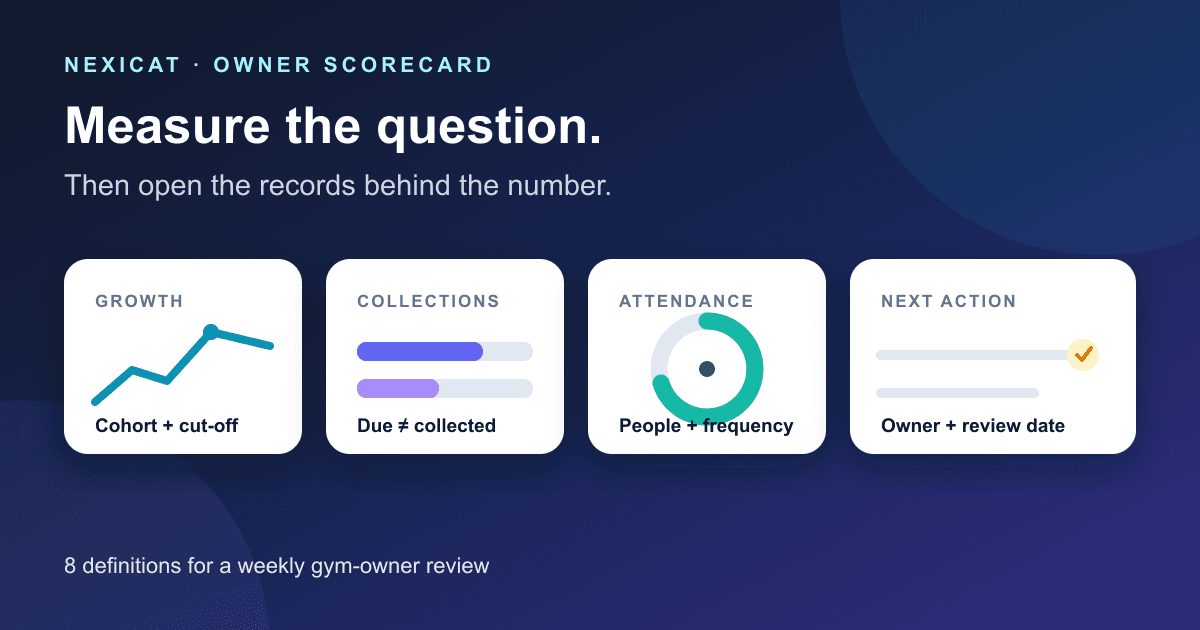
Before the metrics: write five scorecard rules
A dashboard becomes useful when everyone knows what each number means. Before calculating a KPI, write down:
- Question: what decision should this metric inform?
- Definition: the exact numerator, denominator, statuses and exclusions.
- Window: which dates or cohort are included, and when the result becomes final.
- Source: which member, invoice, attendance, booking or lead record is authoritative.
- Owner: who investigates a change and when they report back.
Reviewing a metric every week does not mean every metric uses seven days of data. A renewal cohort may need a month and an agreed follow-up cut-off. A class show rate may use four comparable weeks. Keep the calculation window stable when comparing periods.
Do not copy a benchmark without checking its market and method. The Health & Fitness Association’s FIT Tracker methodology, for example, describes modelled US foot-traffic data, its panel and its definitions; it is useful research but not a target for an individual Indian gym’s recorded check-ins.
1. Net member movement
Count memberships that became active during the period, then separately count memberships that ended under your agreed definition.
Net member movement = new activations − ended memberships
Keep the two components visible. A net result of zero could mean 3 activations and 3 endings or 40 activations and 40 endings; those situations require different action.
Define “ended” carefully. Do you count a plan on its scheduled end date, only after the follow-up window closes, or when a cancellation is confirmed? Treat approved freezes separately so a paused member is not silently counted as lost. Avoid adding trial visitors or unpaid records to paid activations.
Use the metric to ask whether the change came from lead flow, conversion, renewal timing or record cleanup. It does not by itself explain retention or demand.
2. Lead-to-paid-member conversion
Start with a fixed group of new leads created during the same period. Give that group enough time to visit and decide, then count how many became paid members.
Lead-to-paid conversion = paid members from the cohort ÷ total valid leads in the cohort × 100
Worked example only: 50 valid leads are created in August. By the chosen cut-off, 10 have become paid members. Conversion is 10 ÷ 50 = 20%. This is arithmetic, not a Nexicat customer result or an industry benchmark.
Do not divide this week’s memberships by this week’s leads; many memberships came from earlier enquiries. Exclude test records and exact duplicates using a written rule, not because they make the result look better. Compare sources only after staff record them consistently.
Platform interactions are not always leads. Google’s Business Profile performance documentation explains, for instance, that the calls metric represents clicks on the call button. Your gym should count an answered, qualified enquiry according to its own lead definition rather than relabelling every click as a prospect.
3. Renewal completion for a due cohort
Create a cohort of memberships whose effective end date falls inside one period. After the gym’s stated follow-up cut-off, count members with a confirmed new paid period.
Renewal completion = confirmed renewals ÷ renewable memberships due × 100
Define which records are not renewable, such as a one-off programme that was never sold as renewable. Keep freezes, disputed payments and decisions still in progress visible rather than forcing them into renewed or lost.
Compare like with like: annual and monthly plans can behave differently, as can new and long-standing members. Segment only when each group remains large enough to interpret responsibly. Use the result to examine record accuracy, plan fit and follow-up execution; do not assume a message or discount caused the outcome without a controlled comparison. See the renewal reminder workflow for the operational checks behind the number.
4. Amount due, amount collected and outstanding balance
Keep contracted or invoiced amounts separate from money actually received. For invoices due within the same period:
Collection rate = amount collected against those invoices ÷ amount due for those invoices × 100
Also show the rupee amount still outstanding and the number of affected invoices. A high percentage can hide one material unresolved balance; a low percentage may reflect one timing issue across many small invoices.
Reconcile cash, UPI, card and other approved methods to the invoice or sale record. Do not treat a screenshot or a member’s statement as settled until the authorised team checks the transaction. Separate pending, partially paid, paid, refunded and cancelled records.
This is an operational collections view, not a definition of accounting revenue, profit, tax liability or cash flow. Ask your accountant how sales, GST, refunds, advance receipts and recognised revenue should appear in your financial statements.
5. Active-member visit participation
Count unique active members with at least one valid check-in during the chosen period, then compare them with members who could reasonably use the facility in that period.
Visit participation = unique active members who checked in ÷ eligible active members × 100
Define eligible active members. Exclude future-start memberships, and decide how approved freezes or branch-only access are handled. A member with five visits still counts once in the numerator; this metric asks how widely the active base participated.
Before interpreting a fall, check whether the scanner, QR process or manual fallback captured visits consistently. Attendance indicates recorded presence, not satisfaction, exercise quality or the reason someone stayed away. Use an inactive-member list for respectful follow-up, never for public ranking or health conclusions.
6. Visits per participating member
Participation and frequency answer different questions. Once you know how many unique members visited, calculate:
Visits per participating member = total valid check-ins ÷ unique members who checked in
If 120 unique members create 360 valid check-ins, the result is 3 visits per participating member for that period. This is a worked example only, not a recommended target.
Deduplicate accidental repeat scans using a documented rule. Keep staff attendance and member attendance separate. Compare the same branch, day pattern and period length, especially around public holidays or temporary closures.
Use frequency alongside participation. Rising frequency among a small group can make total footfall look healthy while much of the active membership has not visited. Neither measure proves that attendance caused a renewal.
7. Class seat utilisation and show rate
For each class occurrence, keep physical capacity, final confirmed bookings and attended members separate.
Seat utilisation = attended members ÷ available capacity × 100
Show rate = attended members ÷ confirmed bookings at class start × 100
A class can have a strong show rate and low seat utilisation if few people booked. It can also fill its booking list but lose usable capacity to no-shows. Review both metrics by class, day and time before changing the schedule.
Use the final confirmed roster after valid cancellations and waitlist hand-offs so one seat is not counted twice. Do not compare a ten-person reformer class directly with a forty-person group class without context. The class no-show and waitlist guide explains the status definitions that make these calculations reliable.
8. Trainer client load and coverage
Count active clients currently assigned to each trainer, then identify members who require an assignment under your service but do not have one.
Assigned-client load = eligible active clients assigned to a trainer
Coverage gap = eligible active clients requiring support but without an assigned trainer
This is a workload and continuity view, not a staff-performance score. A trainer serving specialised clients, leading classes or working fewer scheduled hours may appropriately have a smaller list. Add the relevant schedule and service context before moving assignments.
Avoid ranking trainers by renewal or attendance alone. Member outcomes depend on plan, schedule, health, price, facility experience and many factors outside one employee’s control. Use the metric to find unowned clients, overloaded hand-offs or missing records, then speak with the team.
Turn the scorecard into a 30-minute weekly review
A practical review produces decisions, owners and dates. For each KPI:
- Check data completeness and any definition change.
- Compare with the previous equivalent period or mature cohort.
- Identify the component that moved, not only the headline percentage.
- Open the underlying records and sample exceptions.
- Choose one action, one owner and a review date.
Do not change five processes after one unusual week. Note holidays, branch closures, campaigns, price changes and system outages. When you run an experiment, state the eligible group, start date and outcome measure before it begins.
Keep member-level and finance details inside authorised records. The owner scorecard can show totals while the follow-up list is restricted to staff who need it.
Build the review from Nexicat’s operational records
Nexicat provides dashboards and report workflows across sales, clients, staff, attendance, classes, leads and inventory. Verified reports include revenue mix, membership and renewal sales, outstanding collections, new-client growth, member footfall and visit frequency, class demand and seat utilisation, lead-source conversion, and trainer-client load.
These reports organise the underlying records; they do not create a universal target or prove causation. The formulas and review cadence in this article are editorial guidance, so confirm that your team’s definitions match the fields and statuses it actually uses.
Test a scorecard with your own branch scenario: trace one lead cohort to paid members, reconcile a due-membership cohort, compare recorded attendance with class capacity and check which staff can access member-level details. Explore Nexicat dashboards and reports or book a demo to review the workflow with your own questions.
Bring your scorecard questions to a demo
Turn gym records into decisions your team can explain.
See how Nexicat connects reports across sales, members, attendance, classes, leads and staff. Test your definitions against the underlying records with us.
Questions gym owners ask
Which gym KPIs should an owner review every week?
A focused scorecard can cover net member movement, lead-to-paid conversion, renewal completion, collections, visit participation, visit frequency, class seat utilisation and trainer client coverage. Review the metrics weekly while keeping each calculation window appropriate to the decision.
How do you calculate gym membership retention?
First define a fixed membership cohort, the period, renewal eligibility and the event that counts as retained. This guide uses confirmed renewal completion for memberships due in the same window because mixing new sales, freezes and unfinished follow-ups can make a general retention percentage ambiguous.
What is the difference between gym revenue and collections?
Collections are money recorded as received against amounts due; invoiced sales, recognised accounting revenue, cash flow and profit answer different questions. Reconcile operational records and ask your accountant how taxes, refunds, advances and revenue recognition apply to your business.
What is a good benchmark for gym KPIs in India?
There is no single target that fits every Indian gym, plan mix, city and business model. Start with stable definitions and your own comparable periods. Use external benchmarks only when their geography, facility type, sample and calculation method fit the decision.
About Nexicat Editorial. We write practical guides to gym operations and growth. Sources linked beside the relevant guidance were checked on 10 September 2026. Formulas and calculations are editorial examples, not accounting advice, customer results, industry benchmarks or guaranteed improvements.