
Member experience · India
New Gym Member Onboarding Checklist: The First 30 Days
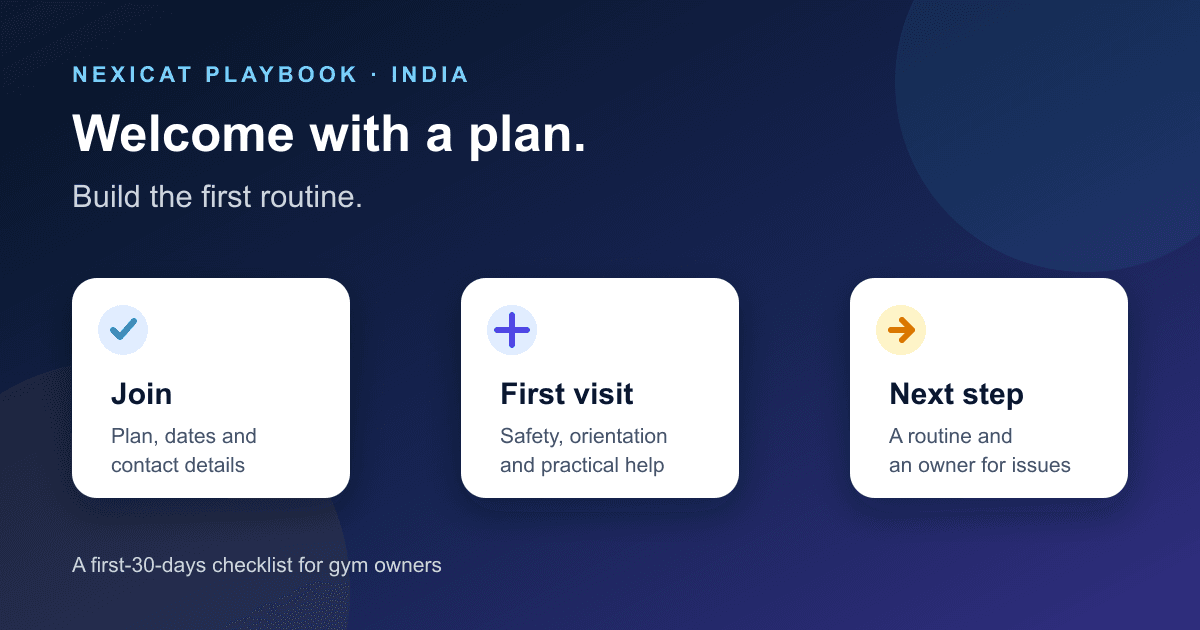
Move each new member from sign-up to a safe first visit, a realistic routine and a clear place to ask for help.
1. Define what onboarding must accomplish
A payment receipt is not a completed onboarding. By the end of the process, the member should know what they bought, how to enter and use the gym, where to ask for help, and what their next visit will look like.
Give one staff member ownership of the hand-off from sale to first routine. Use a small set of internal states such as record incomplete, first visit booked, first visit completed, follow-up needed and onboarding complete. These are operating suggestions, not claims about automatic Nexicat statuses.
Set a clear completion rule. For example, onboarding is complete when the membership record is checked, the member has received a facility orientation, their first practical next step is agreed, and any promised follow-up has an owner and date. A 30-day window keeps the process visible without suggesting that every member needs the same programme or pace.
2. Day 0: create one reliable member record
Before the member arrives, check the information the front desk, trainer and member will rely on:
- correct name and contact details;
- branch, membership plan, start date and renewal date;
- amount received and any balance or agreed payment status;
- emergency contact and the member's permission to store and use it for that purpose;
- optional trainer assignment, preferred visit times or classes, and accessibility needs the member asks you to record;
- the next action, its owner and due date.
Collect only what you need and explain why. Keep health details out of casual free-text notes and restrict access to sensitive information. India’s Digital Personal Data Protection Act, 2023 sets a consent framework based on clear, specific and informed agreement, while the Digital Personal Data Protection Rules, 2025 use phased commencement dates. Check the current timeline and obtain legal advice for your own data practices; this checklist is not legal advice.
Send a welcome note with the branch address, opening hours, first-visit time, what to bring and the correct help channel. Do not bury these details in a promotional message.
3. First visit: orient before you prescribe
Start with the building and the process. Show the member the entrance or check-in method, changing areas, drinking-water point, equipment zones, class area, emergency exits and where staff can be found. Explain etiquette and any branch-specific rules in plain language.
Offer an appropriate pre-activity screening before exercise begins. The American College of Sports Medicine’s facility guide says every adult member should be offered screening and highlights referral of relevant conditions or risk factors to a qualified health professional. Staff should not diagnose a condition or promise a medical outcome.
If the member wants coaching, agree on a starting activity that fits their stated goal, experience and any professional advice they have received. Demonstrate only what the staff member is qualified to teach. End the visit with one concrete next step: a booked induction, an appropriate class, a trainer appointment or a self-directed visit the member understands.
4. Days 2–7: turn intention into a realistic week
Ask when the member can actually attend, including commute, work shifts, family responsibilities and branch hours. A simple two-visit plan they can follow is more useful than an impressive timetable they cannot.
Give the member only the instructions needed for the next visit:
- the day, time and branch;
- whether a class or trainer appointment requires booking;
- what they should do on arrival;
- who to contact if they are unsure or need to change the plan.
If your gym provides member-app access, help them complete registration while a staff member is available. Ask the member to locate their membership details, attendance view and class schedule rather than assuming the login email was enough.
Example check-in message:
Hi [Name], your next visit is planned for [day/time] at [branch]. [Class/coach step, if applicable]. If anything is unclear before you travel, contact [monitored help route].
This is editable editorial wording. It is not an approved messaging-platform template or a claim that Nexicat sends follow-ups automatically.
5. Days 8–14: look for friction, not motivation labels
Review whether the member completed the agreed first step. Attendance can tell you that a visit was recorded; it cannot tell you why a person did or did not come.
If the member has not started, ask a neutral question: “Is the timing, the branch experience or the plan making it difficult to begin?” Offer one relevant adjustment within your actual service, such as another induction time, a suitable class, clearer directions or a call with the assigned trainer.
If they have attended, ask what felt confusing or uncomfortable and confirm the next step. Record the operational issue, the action and the owner. Avoid labels such as “unmotivated” in the member record; they are subjective and do not tell another staff member what to do.
Close the loop on promised fixes. A broken locker, an inaccessible exercise setup or a booking question should not remain as an unowned note.
6. Days 15–30: hand over a routine the member can own
By this stage, the goal is a clear hand-over. Review the member’s preferred times, any classes or coaching they used, what support remains, and the next membership milestone that is relevant to them.
Do not turn a 30-day conversation into an early renewal push. First ask whether the original access, schedule and support are working as explained. Correct record errors and unresolved service issues. Then show the member where they can see plan information, attendance or bookings if those tools are included in their service.
Use this close-out checklist:
- member can identify their plan and branch contact;
- first-visit orientation is complete;
- screening or referral steps are recorded appropriately;
- at least one usable next-visit path is understood;
- open issues have an owner and due date;
- communication preference is respected;
- onboarding status is closed or a follow-up date is set.
Members will progress at different rates. Completing this checklist means the operational hand-off is clear; it does not certify fitness, health or future attendance.
7. Measure the process without inventing a retention claim
Track a fixed group of people who joined in the same period. Useful process measures include the share with a complete record, the share who completed orientation, the share who made the agreed first visit, unresolved onboarding issues and the time taken to close them.
Worked example only: 40 people join in one month. Thirty-six complete orientation, so orientation completion is 36 ÷ 40 = 90%. Twenty-eight make the agreed next visit by the gym's chosen cut-off, so that measure is 28 ÷ 40 = 70%. These are arithmetic examples, not Nexicat customer results, industry benchmarks or evidence that onboarding caused later retention.
Compare cohorts only when the definition and cut-off are the same. Add a short reason code for incomplete onboarding—could not contact, schedule mismatch, record issue, accessibility issue, changed mind or another clearly defined reason. Review the process bottleneck, not a public ranking of staff or members.
8. Keep the onboarding hand-off visible in Nexicat
Nexicat can keep core parts of the hand-off in one member workflow: the gym team can record a membership plan and dates, payment details, an emergency contact, an optional trainer and onboarding notes. When a new member account is created, the platform sends a registration email. Member-facing tools provide access to membership details, attendance history, classes and bookings.
Those records support the checklist; they do not replace professional screening, a qualified coach or a staff conversation. Nexicat does not claim that the suggested 30-day states, check-in messages or follow-up cadence in this guide run automatically.
Before choosing any system, test the real journey with your team: add a sample member, check the plan and dates, assign a trainer when needed, complete account registration, open the member experience and trace the first visit through attendance or booking. Explore member management features or book a demo with your own onboarding scenario.
Bring your real onboarding flow to a demo
Give every new member a clearer start.
See how Nexicat keeps membership details, plan dates, payments, trainer assignment and member access connected. Test your own front-desk-to-first-visit journey with us.
Questions gym owners ask
How long should gym member onboarding take?
Complete essential record, access, safety and first-visit steps before or during the first visit. Use the remaining 30 days to resolve friction and establish a clear routine. The exact pace should follow the member's needs and your service, not a universal timetable.
What information should a gym collect from a new member?
Collect the minimum information needed to provide the membership, contact the member, operate safely and keep accurate payment and plan records. Explain the purpose, respect communication choices, restrict access and get advice on the privacy rules that apply to your gym.
Should every new member have a fitness assessment?
Offer an appropriate pre-activity screening and explain any assessment your gym provides. The scope depends on the activity, member and staff qualifications. Refer relevant medical risks to a qualified health professional; gym staff should not diagnose conditions.
Can software automate the entire onboarding process?
Software can keep member, plan, attendance, booking and follow-up information organised. Facility orientation, professional judgement, accessibility support and human questions still require your team. Confirm each automation a vendor actually supports before relying on it.
About Nexicat Editorial. We write practical guides to gym operations and growth. Sources linked beside the relevant guidance were checked on 5 September 2026. The checklist and calculation are editorial guidance, not medical or legal advice, customer results or guaranteed improvements.