
Daily operations · India
Daily Gym Operations Checklist: Open, Handover and Close
Give every shift a usable opening routine, an exception-based handover and a closing record the next team can trust.
1. Build a checklist people can actually complete
A useful daily checklist names the branch, business date, shift, responsible person and completion time. Each line should describe something the person can verify, not a vague instruction such as “check everything”.
Use three results:
- Ready: the item was checked and can be used as intended.
- Exception: a problem exists, but the approved response keeps operations safe and clear.
- Stop and escalate: the area, equipment or process should not be used until an authorised person resolves it.
For every exception, record the specific issue, immediate action, owner and next update time. “Treadmill 4 isolated; power fault reported to service partner; manager to update by 2 pm” is actionable. “Equipment issue” is not.
Keep separate specialist checklists for pools, saunas, cafés, childcare, physiotherapy or other regulated services. A generic gym-opening sheet cannot prove those areas comply with their technical or local requirements.
2. Opening: walk the branch before the first check-in
The opening lead should physically walk the member route from entrance to workout areas, changing rooms and exits. Check what can be observed without pretending to certify technical systems.
- Confirm the correct staff are present and know who is leading the shift.
- Review unresolved items from the previous close before admitting members to an affected area.
- Check that walking surfaces are dry and clear, lighting is working, and changing areas are usable.
- Confirm designated exit routes are visibly unobstructed and required doors are in their approved operating state.
- Look for obvious equipment damage, loose parts, frayed cables, leaks or error displays. Isolate suspect equipment and follow the manufacturer or service provider’s process.
- Confirm the first-aid kit, fire equipment and emergency contacts are in their assigned locations; use trained or authorised specialists for formal inspections and servicing.
The Bureau of Indian Standards lists National Building Construction Standards 2026 (SP 7:2026) as superseding the 2016 edition. Building and fire requirements still depend on the applicable adoption, occupancy and local authority. Have a competent professional set your approved procedures; this operational checklist is not a fire or building compliance certificate.
3. Make the front desk ready for the day in front of it
Next, confirm that staff can serve the members expected today. Open the source-of-truth systems and review:
- today’s classes, trainers, capacity changes and branch timings;
- expected inductions, trials, appointments and member follow-ups;
- memberships or payments that need a human check before access or collection;
- staff attendance and any coverage gap;
- approved notices about maintenance, closures or changed services;
- the correct escalation contact for access, payment, equipment and member-safety issues.
Test the actual check-in route rather than assuming yesterday’s device state carried over. If internet or hardware is unavailable, staff should know the approved temporary process and how records will be reconciled later.
Where the branch handles cash, an authorised person should verify the opening float using the gym’s finance control. Do not put drawer amounts, alarm codes, keys or passwords on a general checklist visible to all staff.
4. During the shift: run a short operational pulse
Opening checks expire as the day changes. At a time that fits your peak period, the shift lead should review the floor and the records again.
Check whether scheduled trainers and classes are running as recorded, member check-ins are being captured, cleaning and consumables need attention, and any isolated equipment remains clearly unavailable. Look for queues or repeated questions at reception; they often reveal a broken instruction or missing record.
Review open member and lead actions without reading private details aloud in a public area. Assign each next action to a named role or staff member. If a member says a payment is already complete, mark it for verification and pause duplicate collection until the authorised team checks the record.
Keep the pulse short. The aim is to surface exceptions while the team can still act, not to turn the busiest hour into a management meeting.
5. Handover: transfer exceptions, not a stream of chat
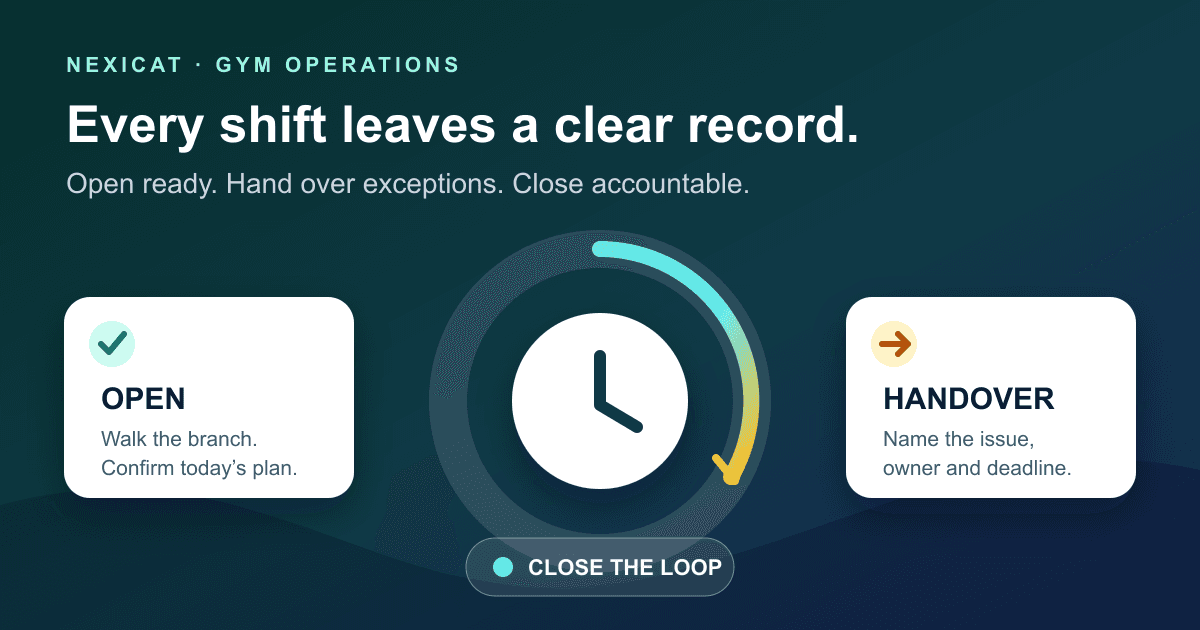
A shift is not finished when the next person arrives. It is finished when the next lead understands what is open, what has already been done and what must happen next.
Use this handover format:
Issue: [specific member, equipment or operational exception]
Current state: [what is confirmed]
Action taken: [what the outgoing shift did]
Next owner and deadline: [person or role, date/time]
Escalation condition: [when the manager must be contacted]
Separate closed, open and escalated items. Do not make the next shift reconstruct decisions from a long messaging group. Link to the authorised member, sale, booking or maintenance record where possible.
Use the minimum personal detail needed for the task, and keep finance or health-related issues inside the access-controlled system. A general handover should never contain passwords, full payment credentials, medical histories or unnecessary copies of identity documents.
6. Closing: reconcile the day before securing the branch
Start non-disruptive closing work early enough that the final sweep is not rushed. After the last scheduled use, follow the branch’s approved sequence.
- Confirm every member, guest and staff member has left the relevant areas, including changing rooms and studios.
- Return portable equipment to its assigned place and isolate any damaged item found during the day.
- Shut down equipment, utilities and environmental systems only as their instructions and premises plan require.
- Close outstanding class rosters, attendance records, trials, sales and member actions that were completed today.
- Reconcile recorded payment methods with the day’s authorised finance records; restrict discrepancy details to the right roles.
- Log out or secure shared front-desk devices and protect printed material containing personal information.
- Record unresolved exceptions for the opening shift with an owner and update time.
- Complete the approved door, key, alarm and premises-security process without copying sensitive security details into a public template.
The final person should not improvise a lock-up sequence from this article. The building owner, security provider, equipment suppliers and local professionals should define the branch-specific version.
7. Review exceptions instead of counting ticks
A checklist with every box ticked can still hide repeat failures. Once a week, group exceptions by type: facility, equipment, staffing, member record, payment, class, cleaning or access system.
Measure simple process facts: how many exceptions remain open, how long each has been open, which items repeat and how many were closed without an owner. Do not turn these counts into invented safety or service scores.
Worked example only: one branch records 12 exceptions in a week. Nine are closed by the agreed review time, so its on-time closure share is 9 ÷ 12 = 75%. Three remain open and require an owner and new date. This is arithmetic, not a Nexicat customer result or industry benchmark.
If the same issue repeats, change the underlying process. Moving “restock receipt paper” higher on the opening sheet may help once; repeated printer failures may need a service decision. Repeated late class starts may need schedule or coverage changes, not more reminder messages.
8. Use Nexicat records to support the daily review
Nexicat supports the operational records around this checklist. Owners can set staff roles and module-level permissions, maintain staff profiles and attendance history, connect instructors to class schedules, and review dashboards and reports across members, sales, attendance and activity. Staff can check in and out through supported attendance workflows on web and mobile.
Nexicat does not claim that the opening, handover and closing checklist in this article is an automated product feature. The checklist can sit in your approved SOP while Nexicat supplies the member, staff, class, attendance, payment and reporting records the shift needs to verify.
Test a real day before buying any system: give a front-desk role only the access it needs, record a staff check-in, review today’s class and member activity, trace a payment question, and generate the report a manager would use the next morning. Explore staff, permissions and payroll, review dashboard and reporting tools, or book a Nexicat demo with your own branch handover scenario.
Bring a real operating day to a demo
Give every shift a clearer operating picture.
See how Nexicat connects staff permissions and attendance with member, class, sales and reporting records. Test your own open-to-close scenario with us.
Questions gym owners ask
What should a gym opening checklist include?
Include branch and shift ownership, the previous shift's open exceptions, a physical facility walk-through, visible equipment condition, staff coverage, today's schedule, check-in readiness and the approved escalation route. Adapt technical and legal checks with qualified local professionals.
Who should complete the opening and closing checklist?
Assign one accountable shift lead, then name who verifies specialist items. The person ticking a line should be able to observe or perform it and know when to stop and escalate. Attendance alone does not prove that a checklist was completed.
What should be included in a gym shift handover?
Transfer each open issue's confirmed state, action already taken, next owner, deadline and escalation condition. Link to the authorised source record and avoid passwords, security details or unnecessary member information in general chat.
Can gym management software replace an operations checklist?
Software can organise staff, member, attendance, class, payment and reporting records. A branch-specific walkthrough, safety decision, equipment inspection and premises lock-up still require approved procedures and responsible people.
About Nexicat Editorial. We write practical guides to gym operations and growth. Sources linked beside the relevant guidance were checked on 6 September 2026. The checklist and calculation are editorial guidance, not a safety or legal certification, customer results or guaranteed improvements.